If You Plant It They Will Come
Attracting Wildlife to your garden
By Steven Birce

With that in mind, one can see how good planning in the early stages of developing a landscape plan can help create a garden which either enhances or limits the visitation of wildlife to the garden, depending on what is desired by the homeowner. An existing landscape can also be easily modified to achieve the desired results. So whether you are looking to attract the birds or the bees, or keep the deer from eating your prized plants, a little planning will go a long way in helping you realize your goal.
Inviting fauna to share your retreat is a great way to enhance the enjoyment of our personal outdoor space. At the same time we can learn about the way we can be a part of nature, and can contribute to the life cycles of the animals that we are attracting. Whether we realize it or not, we are affecting not only our lives, but also those of the animals around us by the way we plan and plant our landscapes; Everything from plant selection, fencing, and sheltered areas, to the inclusion of water in the landscape. The proximity to existing animal habitats will affect the type, variety and frequency of our animal visitors.
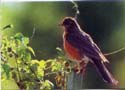
Knowing what wildlife you want to attract (or keep away) is the first step to designing a garden with these creatures in mind. Certain species of birds (waxwings, chickadees, grosbeaks, nuthatches, woodpeckers) can be attracted by planting trees and shrubs which have seeds or fruit that they will enjoy. Trees such as Crabapple, Mountain Ash, Mayday, Russian Olive, and shrubs like Cotoneaster Currant, Gooseberry, Junipers, Dogwoods, Cranberries, and Nanking Cherry would all be suitable.
Along with food, birds also need shelter and water to come to; they need to be convinced to remain and revisit your yard. Therefore, plants should be selected with this in mind; larger shrubs, trees, and evergreens for winter protection. Birdhouses strategically placed and built with certain species in mind can also be useful. Water, in the form of a birdbath pond or stream is also attractive to birds for cleaning, playing and for drinking (especially in the winter).
Butterflies can also be attracted to the landscape by providing the types of flowers they seek; flowers with fragrance and an abundance of nectar. Some examples are Bee Balm, Columbine, Daisies Milkweed, (Monarch Butterfly) Purple Coneflower and Delphinium. Bees will also find these and other flowers to their liking, and should be welcomed into the garden as they provide pollination of plants requiring this to bear fruit. (Unless allergy to bee stings is a concern).
Sometimes visitors come by that are not desired by everyone. While 100% control may not be a realistic goal, steps can be taken to control the arrival of deer, birds & bees, raccoons, and our own feline friends. Birds and bees can be kept at bay by simply not planting plants with fruit and flowers they desire. Deer can be deterred by placing chicken wire around tree trunks and shrubs, spreading blood meal around the property line and planting shrub beds just inside the fence (the deer wont jump if there isnt a place to land). Another way to keep deer away is to plant plants that they dont seem to enjoy as much as others - Cotoneaster, Burning Bush, Potentilla, Spirea, and Spruce.
Wildlife in your garden is inevitable - the type and frequecy can be controlled by you! With a little planning and a little research along with an initial goal of how much "wild you want in your life", you can easily achieve the backyard paradise that suites your taste, your lifestyle and your desire to enjoy nature and all it has to offer.
Editior's Note: " Gardening for the Mind Body and Solace" (Mar/Apr'97). I would like to thank Karen Sanderson R.N., from The Gardening Connection for her contribution of information on therapeutic gardens.

Gardening for the Mind, Body and "Solace"
A Therapuetic Garden
by Helmut Barwich and Karen Sanderson R.N.
As our "quality of life" today is a challenged by
more and more stresses, one can find solace in the garden. As a non-threatening,
relaxing, and enjoyable environment, gardens exude a very therapuetic quality.
One of the keys to managing stress is to balance work and relaxation, while
increasing the feeling of being in control. Gardens provide an excellent means
for achieving this. Gardening allows people to socialize and verbalize their
feelings based on the commonality of the gardening project.
In addition to pure enjoyment, gardens and gardening activities provide a
broad spectrum of benefits to all participants which encompass the physical,
pyschological, social and cognitive.
Most gardeners without limitations in these areas take their access to a garden
setting for granted and enjoy its rich benefits from youth to their senior
years.
The therapeutic garden requires physical design modification to allow a greater
number of us to access its benefits including those who at any age are physically
and/or mentally challenged.
Gardening can be adapted for everyone to participate, reguardless of their
physical ability, and is excellent for stress reduction and health management.
Although gardeners of all ages reap the therapeutic benefits from digging
in the dirt, seniors seem to gain the most. As they age, or after physical
setbacks, working in the fresh air and moving their bodies helps to improve
co-ordination and dexterity or helps retrain their muscles.
Emotionally, the benefits are numerous: self-confidence and self-esteem improve
with the sucessful completion of horticultural projects. To plant a flower
or vegetable garden and to see it spectacular results provides a great feeling
and sence of accomplishment. Frustrations resulting from a hard day can easliy
be relieved through physical activites of hoeing, weeding, repotting and planting.
As more seniors are choosing to stay in their own homes longer,a few simple
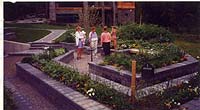
adjustments can be made to accommodate them. Raised beds ( raised planter
edge seating should be a minimum 30 cm wide and 45 cm in height.) and container
gardens (height of containers should be 60 cm) can make gardening possible
for even those with limited mobility.
With good planning in the design process, simple conveniences, like lever
control taps to major design modifications that provide pathways for wheelchair
access (minimum 1.5 m wide for turn-around space), seniors should be able
to continue to garden on their own.
Adequate seating is recommended, "You have to take time to sit and enjoy
the fruits of your labour- that is why it is so important to plant flowers
that are aesthetically and sensory pleasing. Plant flowers that have pleasant
scents, vary in texture and flower in continuous sequence."
"You want to bring the beauty of nature in to your garden." "Shut-ins"
can benefit from flowering trees, shrubs, perenials and annuals, providing
a sence of daily and seasonal changes. And don't forget to add features like
bird baths and feeders and trees that attract birds ( Mountain Ash attracts
waxwings) and flowers that attract butterflies.
It lifts peoples spirts to see nature in the form of wildlife come to visit
their own back yard. Plants for outdoor gardens should be selected to form
an ecosystem that attracts birds.
Water is also an important aspect in the garden. The sound of running water
is both refreshing and very soothing. Garden modification can be made at the
home garden to extend the enjoyment of independence and familiar enviroment
or can extend to the institutional setting, where the therapeutic garden can
be seen as a tool for the treatment of physical, psychological and social
disorders or for those who would just use these gardens for pure enjoyment.
The size of a therapeutic garden does not matter- a condominium balcony would
be sufficient. What is important is that it is well designed, easily accessible
and filled with beautiful plants that are sure to improve the lifestyle and
sence of wellness, not only of the gardener but of whomever may visit and
share the garden.
